
Talking Points
The Fed delivers a dovish hold. Warsh seems OK with higher yields and volatility. FX intervention supports the yen but the won fell back as soon as it ended. I expect JPY to re-test 160 soon.
It was an eventful week for central banks. The Fed decision seems to have caught many investors wrong-footed (again); coordinated foreign exchange intervention by the authorities in Japan, South Korea and the US managed to surprise even those investors who were expecting intervention of some kind; and Bank Indonesia’s Governor resigned.
I’ll discuss each of these in turn, plus a review of markets with a focus on the CNY exchange rate and conclude with a look at the the week ahead.
No change in Fed Funds, but it’s not a “pause”
I’ll start with the Fed both because it’s the central bank for the dominant reserve currency and because last Wednesday’s decision once again caught many people by surprise.
The decision not to change the Fed Funds rate was widely expected. Options implied only about a 30% probability of a hike last week so most investors were probably expecting the announcement we got. But whereas in June market participants interpreted Warsh’s comments as hawkish — December 2026 Fed Funds futures jumped 12bps on the day to fully price in a rate hike by year-end and the two-year Treasury yield jumped 15bps — last week’s decision was interpreted as very dovish.
“The Committee remains resolute. You’ve heard this before, but we will deliver price stability”. Yes, they’ve heard it before. And it seems many investors no longer believe it. Inflation has been above target for five years and Warsh isn’t showing the impatience with that track record he claims to feel. So the two-year Treasury yield fell 4bps; December Fed Funds futures fell 9bps; five-year breakeven inflation rose 8bps; and the thirty-year yield jumped 11bps. Markets priced in lower rates and higher inflation. Even equities didn’t like it: US stocks fell 1.5%.
Warsh’s act is wearing thin. It’s one thing not to provide forward guidance. It’s another not to explain your reasoning or to provide any sense that you have a model or even a base case for the economy and rates in mind. Warsh’s muddled referee analogy for the Fed hints at a fundamental misunderstanding. The Fed is a player. He describes bond markets under Powell — and previous Chairs — as slavishly following the lead they got from the Fed on the future path of rates. But the Fed sets the very short-term rates and, QE aside, the market determines the long-term rates. I’ve never met a bond trader who didn’t think they had a better forecast for the US economy — and therefore a better view on the future path of policy rates — than the FOMC.
Warsh acknowledges that the Fed’s views are very important, but is removing that information from the market. So, as I said when he was confirmed we’ll get more volatility in rates without that key source of information.
Worse, Warsh’s steadfast refusal to answer questions about how the Committee arrives at decisions or what signals he is learning from the supposedly newly empowered bond market is being taken as a sign of intellectual weakness. He doesn’t want to explain himself because he doesn’t know himself.
But his insistence that not hiking rates should not be described as a “pause”, while true in the sense that you can’t pause something you haven’t started, reveals something important about how he thinks about policy. Perhaps because he is unsure whether rates should be going up or down, he’s happy to let the bond market decide for him. In the weeks since the June FOMC meeting, the two-year yield had risen 6bps, the ten-year yield rose 12bps and the thirty-year yield rose 16bps. He applauded these moves. So a broadly higher trajectory for yields is what he thinks is appropriate. But he refused to say what the Fed would do if the Committee thought markets were moving in the wrong direction.
This privatization of policy perhaps explains his reported proposal to reduce the number of FOMC meetings. But FOMC meetings won’t always be non-events. There will be times when the Committee wants to change direction. If the Warsh Fed isn’t going to provide any guidance or description of a reaction function then decisions will be more likely to come as a surprise. The longer the time gap between meetings, the greater the likelihood that rate changes will have to be larger to catch up to changing economic conditions. So again, a core feature of the Warsh Fed will be higher interest rate volatility.
Three Committee members — Kashkari, Hammack and Logan — dissented in favour of a rate hike. In statements in the days after the meeting, they argued that the Fed needs to back up its “trust us” message with some action and that the longer they delay the larger the eventual rate hike may have to be. Warsh is apparently OK with that.
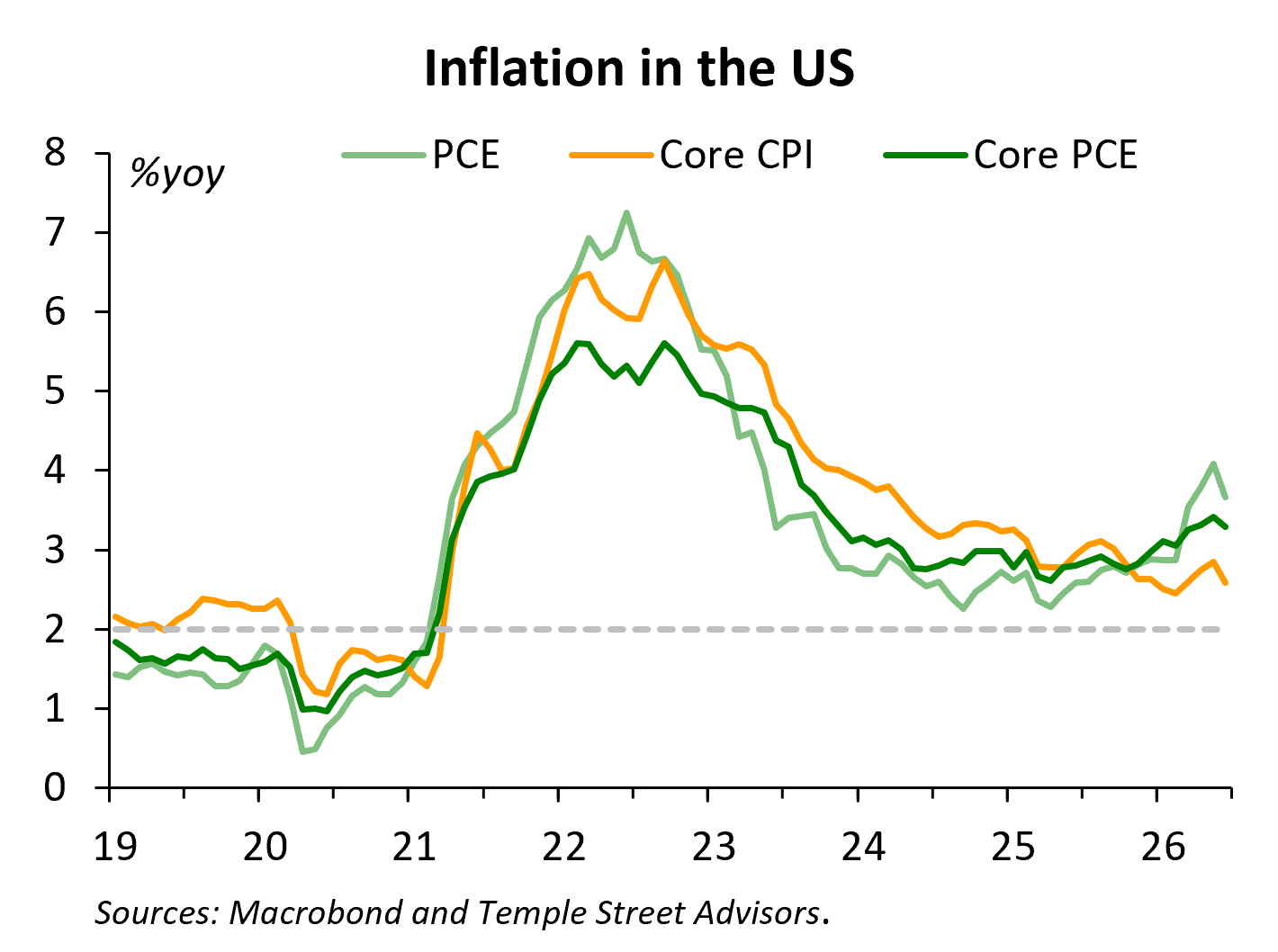
The best argument for not hiking rates last week could have been that inflation is weakening. Hope isn’t a strategy, but the June CPI report was softer than expected and the same was true of the PCE report issued the day after the FOMC meeting. The headline PCE price index fell 0.1%mom(sa), the first decline in four years, while the core price index rose only 0.1%mom(sa), the lowest in sixteen months. Warsh dismissed the June CPI report as potentially a one-off. He’s not wrong. But he missed a chance to at least offer an explanation why the rate hike case might not be so cut-and-dried. The July CPI and PCE reports could be very important: do they continue this downward move in inflation or was that indeed a one-off?
Japan intervenes but doesn’t change policies
The Bank of Japan’s Policy Board met on Friday and kept rates steady. That wasn’t a surprise — after having hiked rates in June the BoJ was not expected to raise rates again so soon. Instead, the night before the authorities had intervened in the foreign exchange markets, buying an estimated USD59bn worth of yen in the New York morning trading hours. This compares with more than USD70bn of intervention in April/May.
Even that wasn’t a surprise — there had been enough warnings that intervention was imminent. But it coincided with intervention by the Bank of Korea to buy won. Both currencies strengthened abruptly in response to the surprising show of resolve to counter market forces. And then on Friday in New York hours, the US Treasury bought yen — selling euros, though, not dollars. The combined effect of these interventions pushed the yen up 3.7% against the dollar on Friday afternoon in New York versus Wednesday afternoon. That’s much more impactful than the May intervention, which pushed the yen higher by just over 2%.
But the fact that the May intervention was quickly reversed — JPY/USD was back above 160 a month later — and had to be repeated last week is a reminded that intervention alone is usually ineffective. Note that the Treasury didn’t buy KRW on Friday and that currency gave back all of its Thursday gains. So the BoK intervention had a one-day impact.
So contrary to the enthusiasts for foreign exchange intervention, I expect the yen will soon enough be heading towards 160/USD.
As I have explained often, most recently last week, the yen has not, over the past year, been driven by bond yield differentials as it had been for some years. There’s a case perhaps that short-term rates have become more influential since the Iran War — rising TONA futures relative to Fed Funds futures in recent weeks have been associated with a weaker yen. But the opposite had been true last year.
I think that the shift in monetary policy in Japan to an explicit tightening policy — persisting even if inflation isn’t cooperating — has broken down the understanding that the BoJ would keep yields low to help the government manage its high (gross) debt levels. And it is that loss of confidence that is leading to capital outflows and a weaker yen.
So the BoJ view that a weak yen contributes to inflation (as I showed last week, that’s correct) and can be solved by higher rates doesn’t hold up to scrutiny. Higher rates appear to be discouraging investment in Japan by pushing debt service costs higher. Prime Minister Takaichi’s fiscal stimulus plans only adds to the pressure.
The policy debate in Japan essentially comes down to a conflict between the Bank of Japan’s new mission to ‘normalize’ rates now that deflation has ended, and the Ministry of Finance, which would prefer the BoJ not raise rates. The timing of last week’s intervention was not a coincidence. Intervention was a replacement for a rate hike. Except that to stabilize the yen, the government would need to tighten fiscal policy. Which they won’t do. Yet.
So the yen will resume its depreciation as soon as the threat of intervention is removed.
Meanwhile, inflation in Tokyo in July was a little higher than in June. Headline inflation rose to a seven-month high of 2.0%, mainly because food prices are rising at their fastest pace in 17 months. Core-core inflation rose for a second consecutive month, also to 2.0%. Note that the nationwide core-core inflation rate fell in June while Tokyo’s rate had risen. Adjusted for non-tax measures like school fee and lunch reductions, nationwide core-core inflation was 2% in June, down from 3.6% a year earlier.
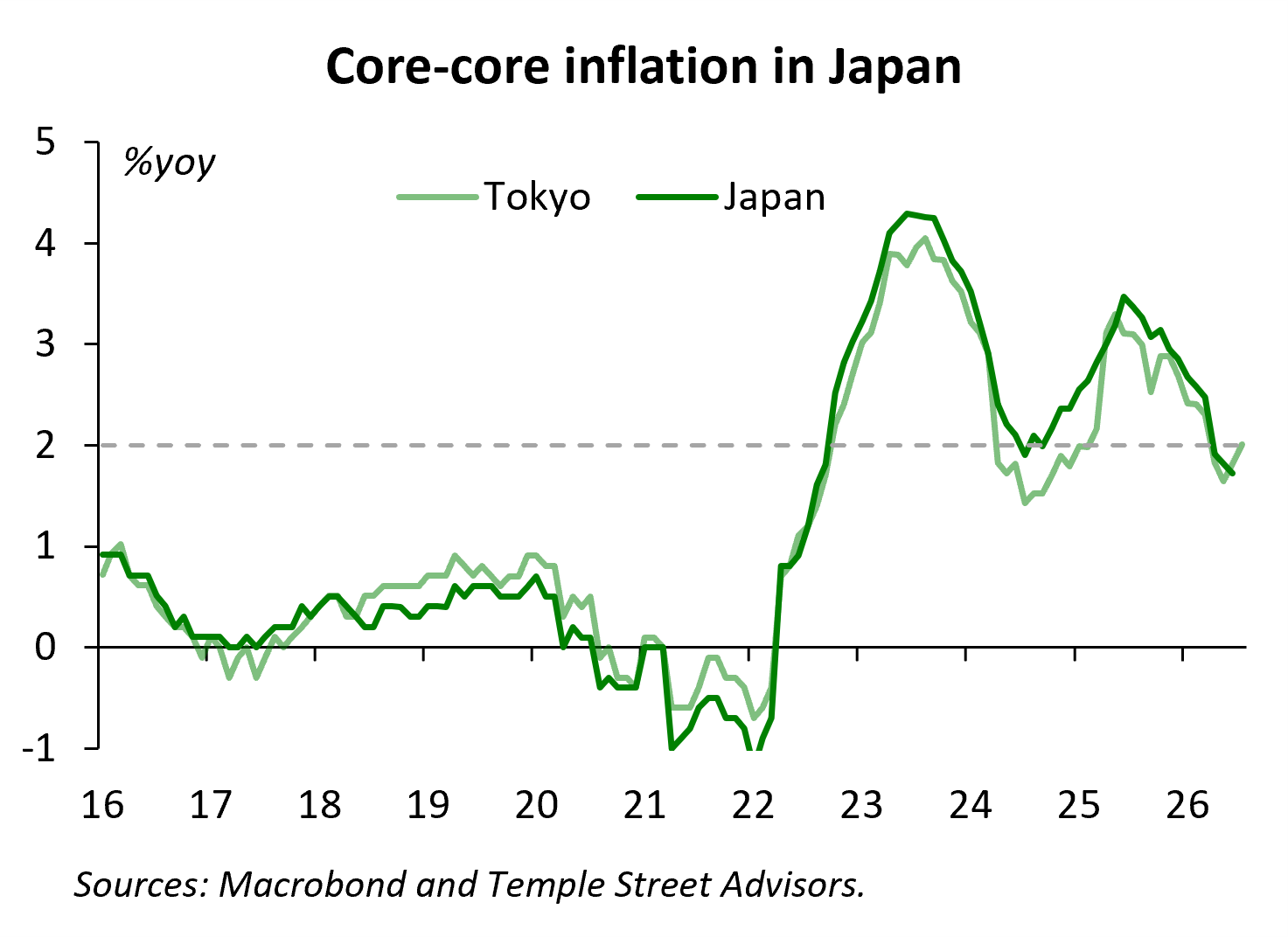
In their report on the economic outlook, the BoJ struck a hawkish tone, arguing that “underlying inflation” is expected to rise above 2% in the second half of the fiscal year begun in April and fall back towards the target next summer. The Tokyo CPI data would appear to be consistent with that view, potentially indicating inflation has bottomed out.
The concept of “underlying inflation” in Japan is much broader than a measure of core inflation. As I reminded readers last week, every measure of core inflation in Japan is at or below the 2% target and falling. By those measures, the idea that “underlying” inflation is rising towards 2% is incorrect. But “underlying inflation” includes inflation expectations that, whether measured by surveys or market measures like breakeven inflation rates are rising — and in the case of the latter, from below 2%. Underlying inflation also includes the BoJ’s models and forecasts. So even though core, core-core and trimmed mean inflation rates, etc, are falling, the BoJ still believes that the “underlying” trend to inflation is rising.
Bye-bye Perry
Bank Indonesia Governor Perry Warjiyo resigned on July 25, only days after the last Board meeting decided to keep rates unchanged. Perry is well respected by investors for his long tenure at BI — he joined the central bank in 1984 and spent three years (2007-09) as the IMF Executive Director for Southeast Asia — and his departure, coming less than a year after the resignation of Sri Mulyani as Finance Minister and at a time of renewed supply-side inflation pressures posed by the war in Iran, was not well received. The IDR was the only APAC currency to depreciate against the USD last week.
Keep reading with a 7-day free trial
Subscribe to The Asia Economist to keep reading this post and get 7 days of free access to the full post archives.