
Talking Points
It is important for leaders to meet face to face, but what Xi and Trump learned last week is that on the issues that matter most to them, the other side isn’t going to be helpful.
It took a few days, but eventually we got enough detail out of the White House to conclude that President Trump’s visit to Beijing last week only fell a little short of expectations. In last week’s Talking Points, I described my expectations for the summit as follows:
“So perhaps this week we’ll see Trump demand that China increase imports of corn, rice, wheat, beef etc. Meanwhile there’s lots of speculation that Xi will commit China to buying 500-600 Boeing aircraft valued at about USD100bn based on list prices.
The US would want China to commit to further relaxing — and for longer — export controls on rare earths, while China would want the same for US controls on sales of semiconductors and semiconductor manufacturing and designing technology.
As long as this truce in the trade war continues — and maybe Trump and Xi agree already this week to extend it beyond November — tariffs are perhaps an acceptable cost of doing business with the US.
We’re likely to see at least more clarity on Trump’s Board of Trade idea, a technical working group that would continue discussions on trade issues, and perhaps also a Board of Investment to do the same for cross-border investments.
Trump may ask Xi to stop supporting Iran. I doubt he’ll get very far.
Xi will ask, again, that the US make clear that it is opposed to Taiwan independence. The current US policy is that they do not support it, which is not as forceful as the Chinese side would like … But Trump wants Xi’s help to arrange a summit with North Korea’s Kim Jong Un, so he will likely avoid pushing to hard against China on these issues.”
The White House released a Fact Sheet on the talks on Sunday afternoon that claims Trump and Xi agreed to the following:
that the United States and China should build a constructive relationship of strategic stability on the basis of fairness and reciprocity. President Trump will welcome President Xi for a visit to Washington this fall.
that Iran cannot have a nuclear weapon, the Strait of Hormuz should be reopened and that no country can be allowed to charge tolls for passage through the Strait.
that North Korea should give up its nuclear weapons.
that “As the cornerstone of this historic agreement, President Trump and President Xi chartered two new institutions to optimize the bilateral economic relationship: the U.S.-China Board of Trade and the U.S.-China Board of Investment.”
that China will address U.S. concerns regarding supply chain shortages related to rare earths and other critical minerals and regarding restrictions on the sale of rare earth production and processing equipment and technologies.
that China will purchase 200 Boeing aircraft and USD17bn of agricultural goods each year through 2018 in addition to the soybeans it agreed to buy last November.
that China restored market access for U.S. beef by renewing expired listings of more than 400 U.S. beef facilities and adding new listings. China resumed imports of poultry from U.S. states determined by the USDA to be free of highly pathogenic avian influenza.
Sounds like a win for the US! Except that this is the US’ side of the story. As is typical for this White House there was no joint statement from the two sides explaining what was agreed. And almost none of the above was corroborated by the Chinese Ministry of Commerce, which summarized the discussions on Saturday. The MoC said that the two sides had agreed in principle to mutual tariff and non-tariff barrier reduction and to Chinese purchases of agricultural goods and to the creation of “trade and investment councils” but said that on all of these subjects the details remained to be worked out.
While Trump’s main aim seems to have been increasing exports to China, Xi Jinping had loftier goals. In their first meeting, Xi asked: “Can China and the United States overcome the Thucydides Trap and create a new paradigm of major-country relations? Can we meet global challenges together and provide greater stability for the world? Can we build a bright future together for our bilateral relations in the interest of the well-being of the two peoples and the future of humanity?”
The US side wasn’t ready to talk about paradigms for relations.
In that first meeting on Thursday, Xi warned Trump that mishandling the Taiwan issue was the greatest potential error he could make and Trump promptly mishandled it. Xi had hoped for a statement from Trump opposing Taiwan independence. He probably would have accepted even a re-statement of the existing US policy that the US doesn’t support Taiwan independence but that future governance of Taiwan is a question to be resolved by the Chinese people — leaving ambiguous how the US would respond to any hostilities (unlike Takaichi Sanae’s more declaratory statement last year). Instead, Trump said he wouldn’t talk about it.
(On his way back to Washington, Trump tried some damage control with comments that appeared to place more of the blame on Taiwan for cross-Strait tensions, which earned him some push-back from Lai Ching-Te. He said that arms sales to Taiwan were just a bargaining chip in discussions with China, which will encourage Xi to believe that a deal on Taiwan can be reached — and scare most Taiwanese people — but also demonstrate that the US position on Taiwan, like so much else, is no longer based on principle.)
So the mood on Friday was decidedly frosty since Xi hadn’t gotten what he wanted from Trump on Thursday. Trump went to Beijing hoping to get some help on Iran. The Chinese side said — just as Xi and Trump were meeting on Friday morning — that the war “should never have happened, has no reason to continue” but offered no help in ending it. They reiterated Xi’s four-point position on Iran, which calls for peaceful coexistence, politically negotiated settlements, shared security and development‑driven cooperation. So, no change in policy. China is opposed to the war but won’t help the US end it.
The White House Fact Sheet says that Xi agreed that there should be no restrictions or tolls on traffic through the Strait of Hormuz and that he agreed that Iran should not have a nuclear weapon. The Chinese side said neither of these things. Trump said Xi offered to help him with Iran; the Chinese said did not say this. Trump even offered to remove sanctions from Chinese companies that buy Iranian oil if Xi would help him end the war. Crickets.
As for the shopping list, 200 Boeings is less than half the 500 - 600 aircraft that the White House had hinted had been agreed before the visit, although the possible sale of 400 - 450 GE Aerospace engines wasn’t touted before the meeting, so may be one genuine achievement. There have been no reports of any ‘deals’ struck by any of the other businesses who went as part of the delegation. Even for NVIDIA’s H200 chips, which the US agreed on Friday could be sold to Chinese companies.
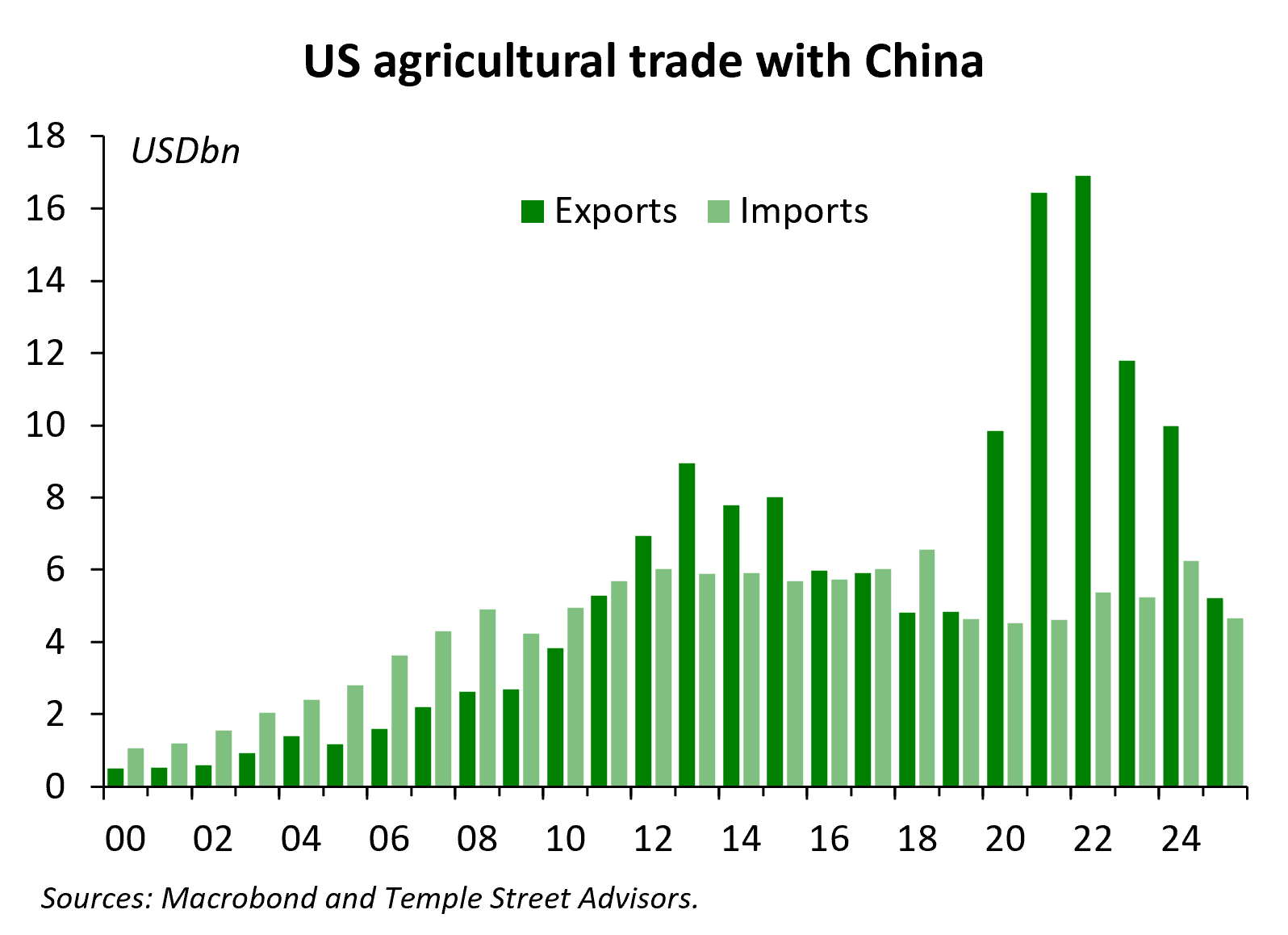
The Fact Sheet says that China agreed to buy USD17bn of US agricultural goods each year through 2028 in addition to the soybean imports that could run above USD10bn per year. There were no details provided and the Chinese side was even vaguer on this point saying details still need to be worked out and linking it to tariff reductions. Agricultural exports to China averaged USD13bn per year over 2020-24 but were only USD5bn last year. If indeed China has agreed to USD17bn per year of imports above the 25mT of soybeans they agreed to buy, total agricultural exports to China from the US could approach USD30bn per year. That would be extraordinary.
Trump made some vague reference to China buying more US oil, but again, nothing specific.
Remarkably, Trump said that he and Xi never talked about tariffs. So there was no agreement to extend the current truce, now six months old — which is to say, due to expire in less than six months. Uncertainty over tariffs and supply chains will rise progressively as that November 10 deadline nears.
Both sides mentioned the Board of Trade (China called it a ‘council’), which had been agreed in broad terms before the meeting. But beyond a commitment (according to the US) that the Board would identify USD30bn of strategically unimportant goods on which tariffs would be lowered, there was nothing else. Tariffs are due to rise sharply in November as the truce that was agreed last November 1 is due to expire. I expect some kind of deal before then to extend the truce, but hopes that that might be announced in Beijing were dashed.
Trying to counter the deliberate instability created by the Trump administration, Xi offered a new framework for relations — “a constructive relationship .. of stability” (we’ll hear about the “four stabilities” from now on I suppose). Xi wants a less unpredictable Trump. Trump has already — with little effort from China — backed down on tariffs and on keeping cutting edge chips out of China. But Xi wants to lock this in with a framework of increased bilateral discussions and commitments — a framework of stability (fewer surprises from the US) to outlast Trump’s second term. The White House paid lip service to the concept in their Fact Sheet; we’ll see if it results in change in how the two sides interact.
So, lots of pomp and pageantry as befits a state visit, but little to show for it. Now, it’s possible that all of these missing ‘deals’ — an extension of the tariff truce, Chinese purchases of agricultural goods and oil, agreement on the Board of Trade’s mandate — will indeed be announced in the coming weeks. But the fact that the White House seemed so sure that these would be agreed last week but weren’t, suggests that the relationship between the two governments from top to bottom, is not conducive to resolving even quite simple issues.
It is important for leaders to meet face to face, but the point of such meetings is to break logjams, to get the highest-level agreement on difficult issues that compels the functionaries to get to work. Instead, the talks seem only to have demonstrated to each side that on the issues that matter the most to them, the other side isn’t interested in helping. That’s good to know, but leaves us all in a more precarious position.
India raises gasoline prices for the first time in four years
India announced price increases of 3% for subsidised gasoline and diesel on Thursday, the first price change since the middle of 2024 and the first increase since July 2022. Prices used to adjust freely in response to crude oil prices, but amid the spike in oil prices after the pandemic, the government suspended that mechanism and haven’t found a way to restore price flexibility.
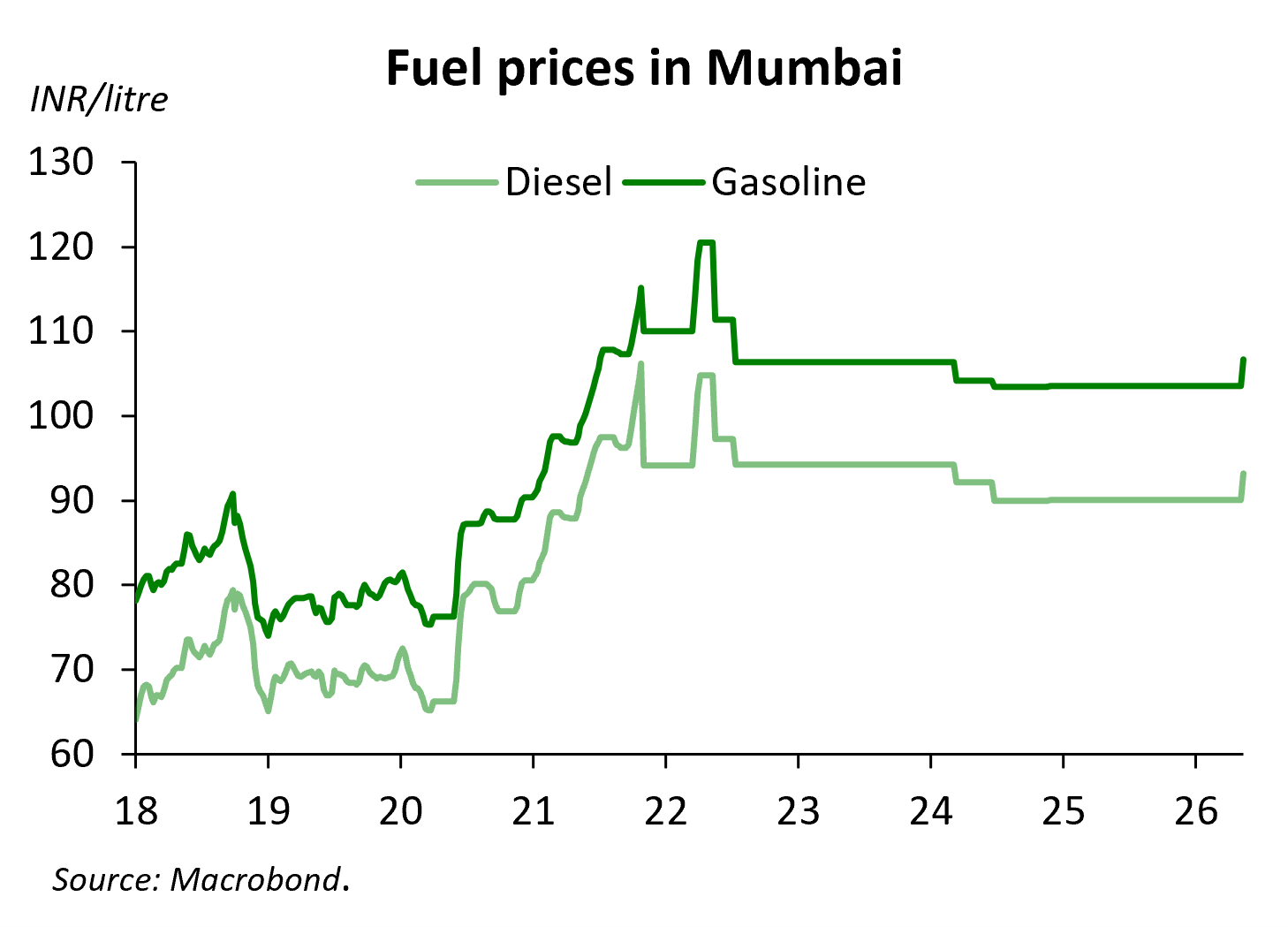
Compared to the price increases in other APAC economies — averaging 25% except in Indonesia and Malaysia where most consumers are still subsidised — a 3% adjustment is tiny. If this is the beginning of a process of raising prices to levels where the subsidy cost to the government returns to where it was when they suspended the pricing mechanism — and I’ve seen no indication it is — by how much would they have to raise prices?
Keep reading with a 7-day free trial
Subscribe to The Asia Economist to keep reading this post and get 7 days of free access to the full post archives.