
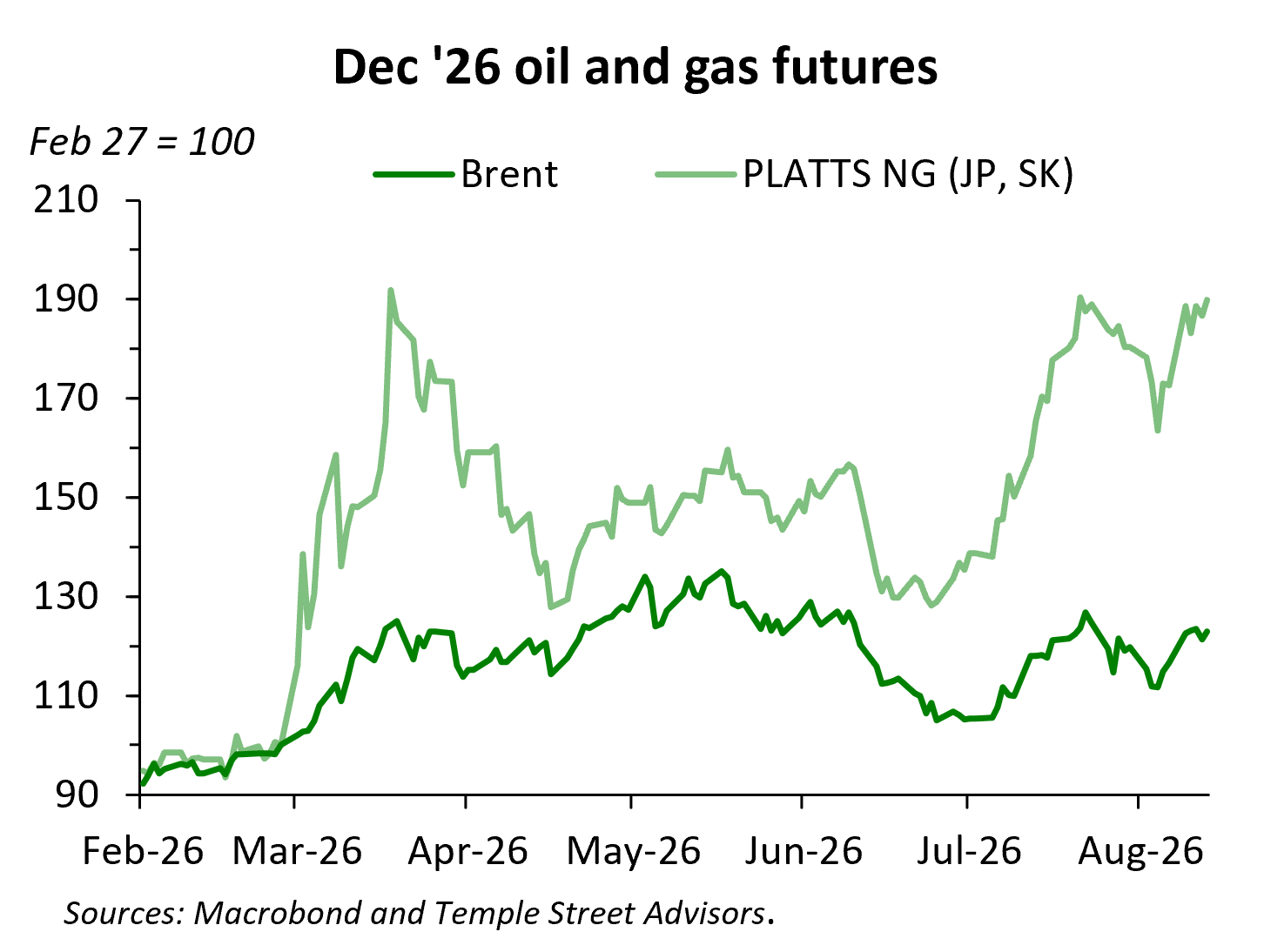
Last week began with rising crude oil and natural gas prices amid renewed attacks on shipping in the Strait of Hormuz and the Red Sea. The rise was stalled — but not reversed — by signals of possible new talks between the US and Iran. But it was enough for equity investors to overcome their jitters and buy into the AI rally again. But the see-saw pattern on oil prices remains a worry for investors and for policymakers. After some benign inflation reports for June and July in many economies, the rise in oil and gas prices over the past few weeks will likely keep inflation risks front and center in policymakers’ minds.
December Brent futures jumped 5.5% last week and are now up 17% from their end-June lows and 23% above the pre-war price. Futures prices for natural gas in Singapore rose 10% last week and are less than 1% below their wartime peaks. The energy shock hasn’t gone away.
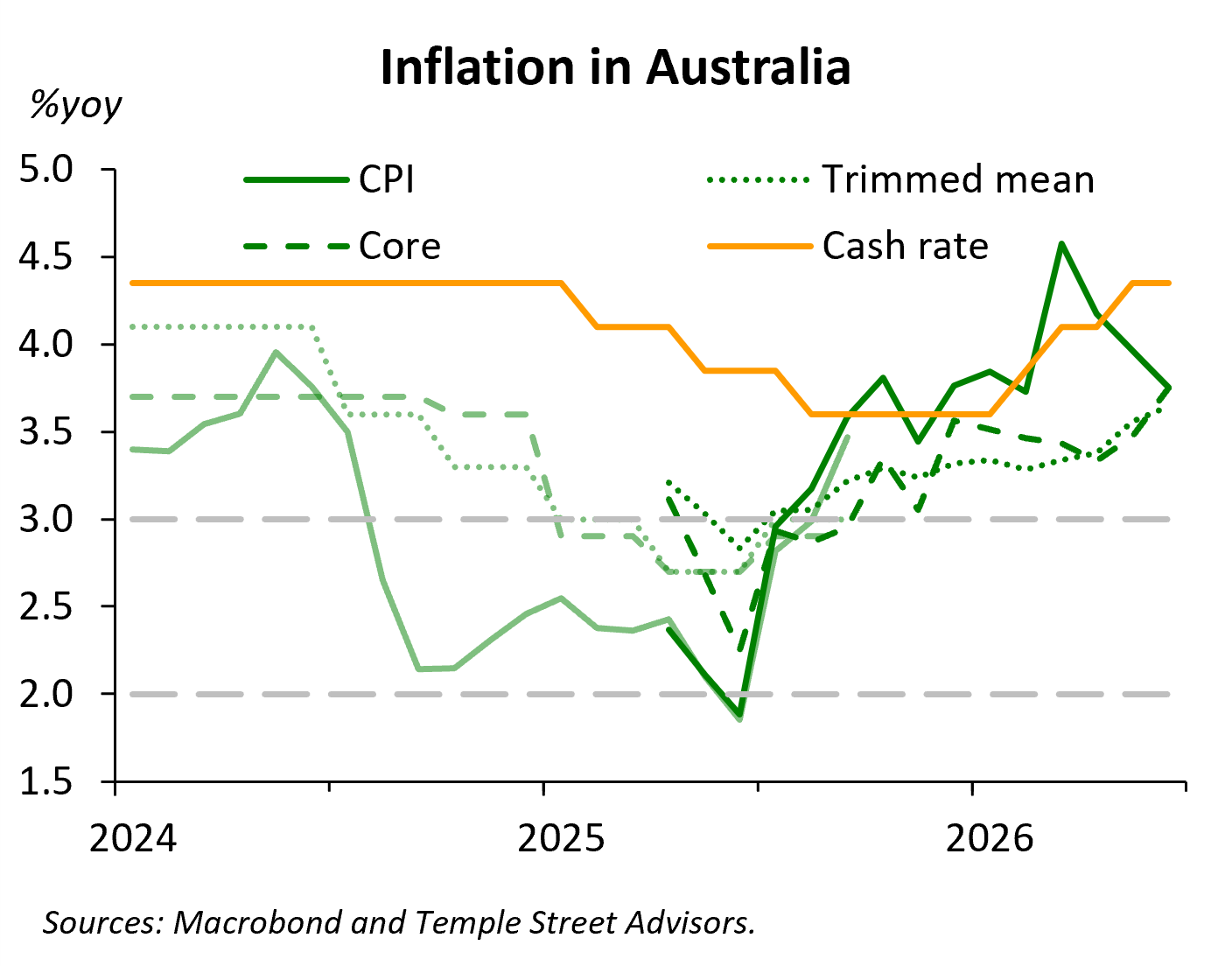
Hence, for example, the Reserve Bank of Australia decision last week not to change its policy rate but to retain a tightening bias. The Board acknowledged that “Resolution of the Middle East conflict remains uncertain, and there are scenarios where inflation is higher and activity lower than forecast.” Headline inflation has come down after a spike up in March, but core and trimmed mean rates are rising. After three rate hikes this year, policy is “somewhat restrictive”. “But inflation is still too high. It is not expected to return to around the midpoint of the target range until late 2027 and there are upside risks to this projection.” Investors are hedging their bets with about even odds of a hike by year-end. I think there will be a rate hike in Q4.
Does China need another Zhu Rongji?
The passing of Zhu Rongji on August 12 at the age of 97 has been recognized in a great many retrospectives this past week on the man and his era of reforms in China. Books have been written on the subject and I’m not going to begin to summarize everything he did. But I’ll offer a few of my own views.
Zhu came to prominence as the Mayor (1988) and also Party Secretary (1989) of Shanghai until 1991 when he was appointed to the State Council and made Vice Premier. His elevation to State Council was a recognition of the value of the reforms he had implemented in Shanghai. He then held the post of Premier from 1998 until 2003. He was concurrently the Governor of the People’s Bank of China for two years starting in July 1993.
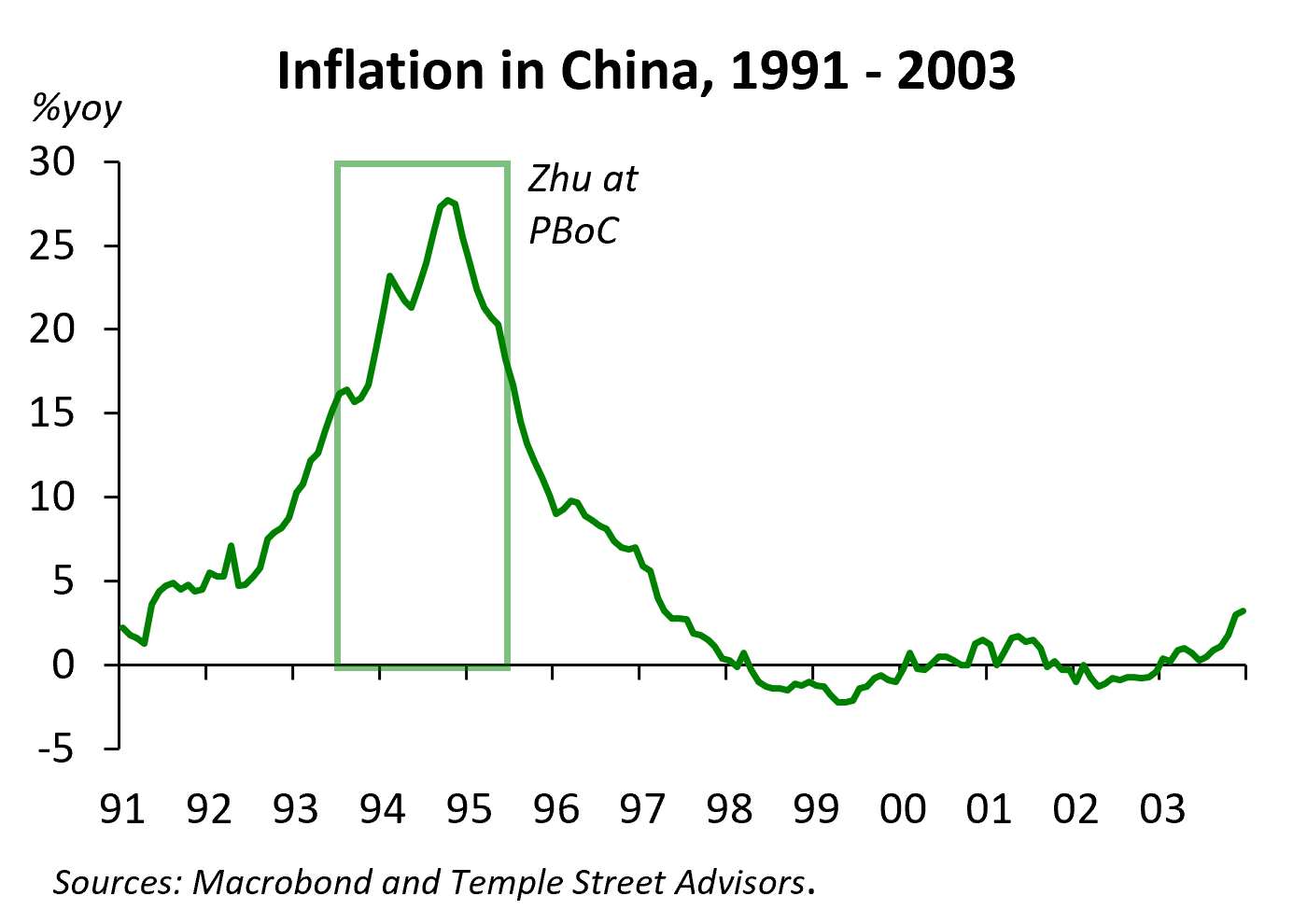
This essentially gave him control over fiscal and monetary policies and over financial regulation at a time of high double-digit inflation. When he joined the PBoC, base money growth was 54% and inflation was 15%. He cut money supply growth immediately and while inflation rose to 28% a year later when money supply growth had been reduced by half, when he left the office money supply growth was 19% and inflation was 18% and falling rapidly.
While some commentators I think have an exaggerated view of Zhu as a free marketeer, I think it is unquestionable that without him reform and opening up would have progressed much more slowly. Deng Xiaoping said that Zhu was the only person on the State Council who understood economics and the vigour with which he pushed reforms and the logic and sequencing of those reforms by and large bear that out. But I think the goal of reforms was both to reinvigorate the Chinese economy and to strengthen the central government.
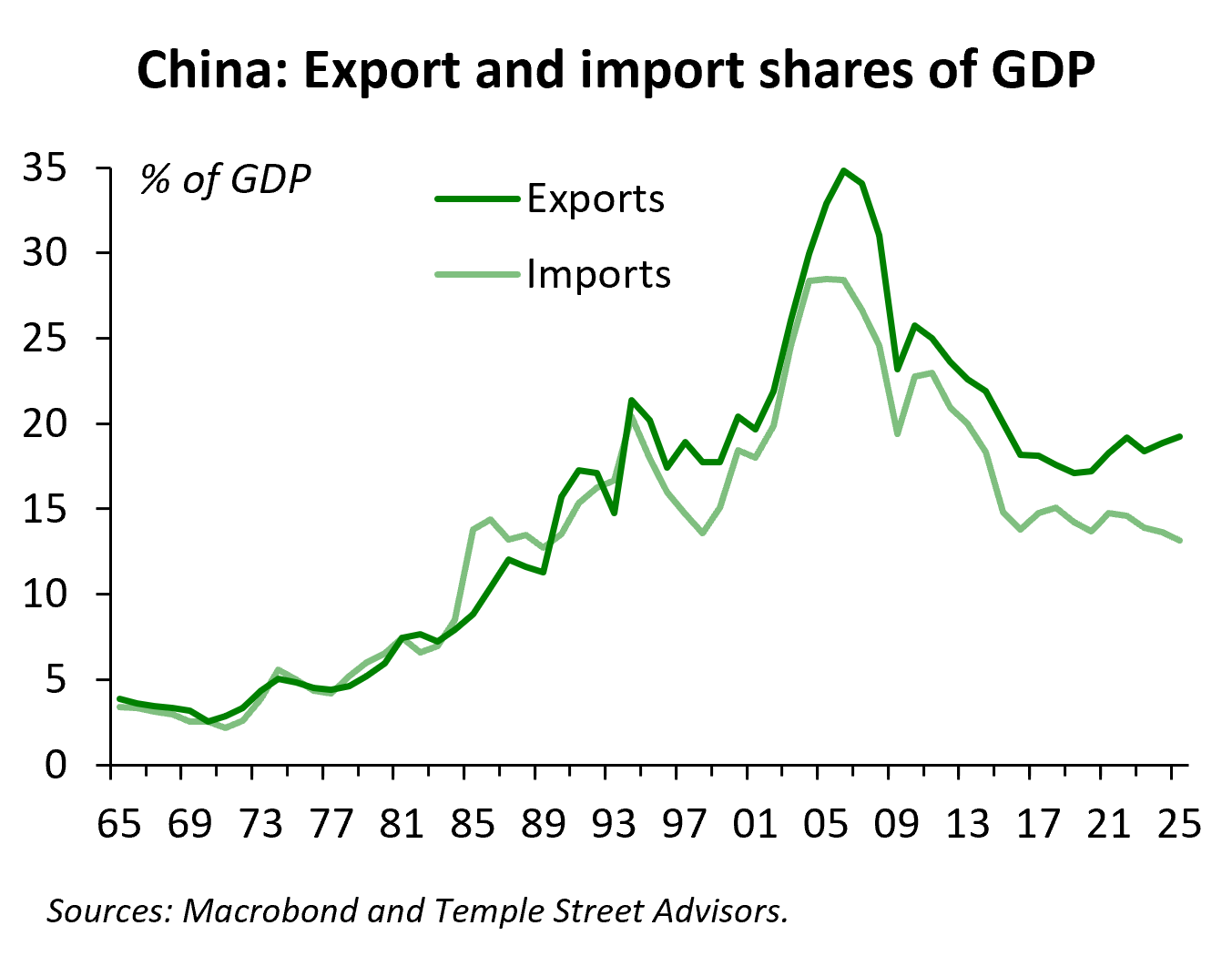
There was probably no part of the economy that wasn’t affected by Zhu’s reforms but there were four main areas of transformation. His most dramatic legacy was WTO accession at the end of 2001. China was already a quite open economy by the time of accession — reforms had begun 23 years earlier and Deng’s Southern Tour in 1992 had reinvigorated the effort — but exports surged immediately afterwards, jumping from 20% of GDP to 35% in 2006. The process of accession had begun in 1986, but Zhu led the negotiations over a decade overcoming considerable opposition both at home and abroad. Those first few years are now referred to as the China Shock 1.0 — from mid-2002 until 2008 export growth averaged 29%yoy and never fell below 20%. China’s share of world exports more than doubled from 4.3% to 8.9% — it has continued to rise since, exceeding 14% since 2020.
WTO accession was viewed by Zhu as key not only for opening up new opportunities for trade and inward foreign direct investments but as a way of disciplining state owned enterprises by opening them up to competition from imports. SOE reforms had begun with the introduction in 1994 of a Company Law, which turned SOEs into corporations, followed by the embrace in 1995 of the policy to “grasp the large, let go of the small”. By 2005, the central government had privatized or closed down perhaps 100,000 small businesses but had consolidated its ownership of the commanding heights — sectors like steel, autos, telecommunications, energy, railways, etc — that were deemed essential. SOEs in those sectors were merged to become giants.
The state’s role changed subtly from one of manager/operator to asset owner. Zhu saw privatization as a way to rid the government of the burden of operating many thousands of small businesses like restaurants and small manufacturing firms of inefficient scale so that it could focus on — and improve the efficiency and profitability of — the ones that really mattered. Along the way, some fifteen ministries and commissions that had previously been needed to manage the SOEs and feed instructions to them were no longer needed and were abolished.
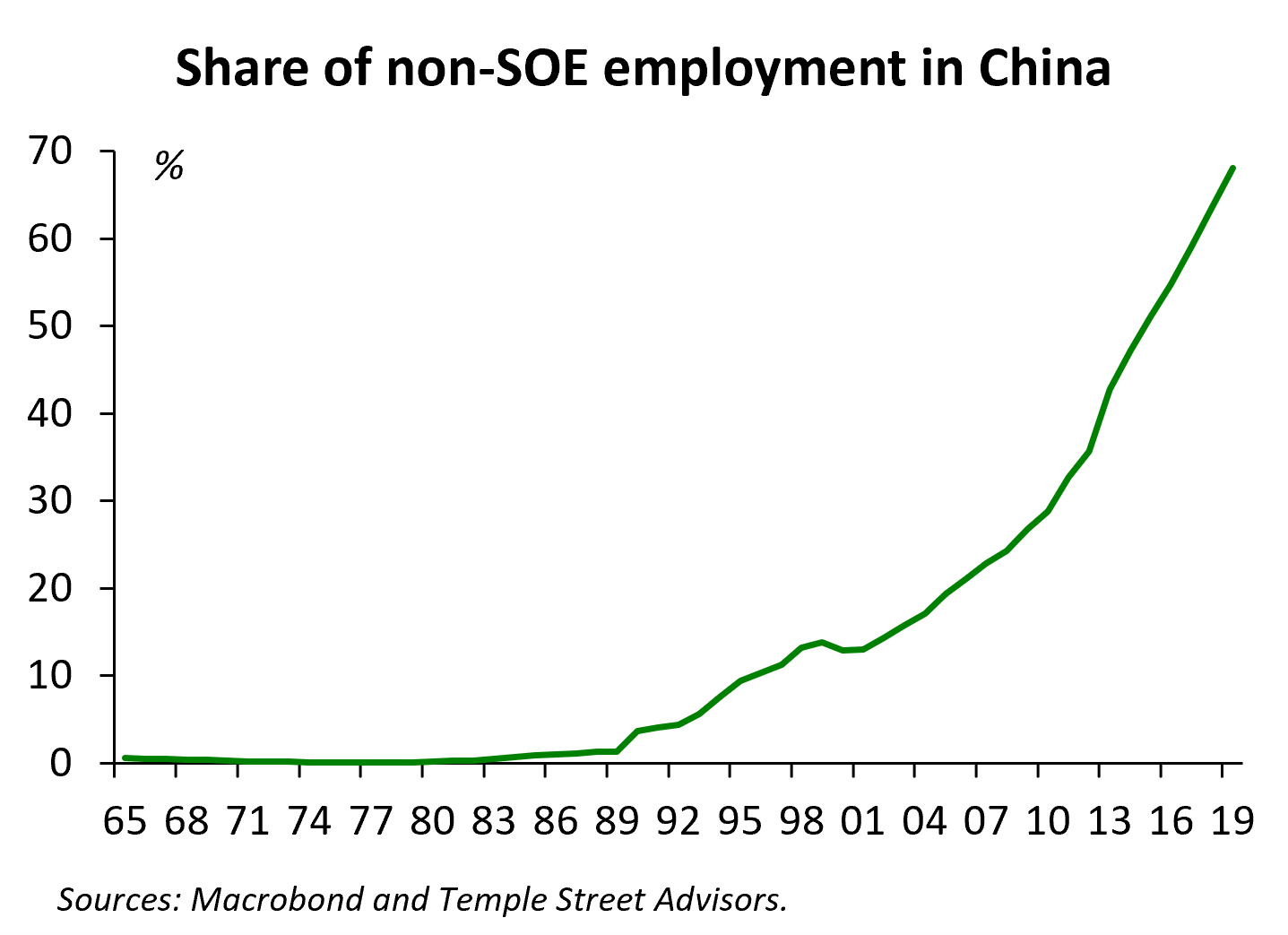
In the process, tens of millions of workers were let go. But this was in the context of rapid economic growth and the entry of far more firms than the government sold. Total employment actually rose more quickly in the peak years of privatization than it had previously (or since), with the result that about one-quarter of the workforce was moved out of SOEs into private firms/self employment between 1995 and 2005. By 2013, fewer than half of people were employed in the state sector and that figure today is probably less than 20%.
The counterpart to SOE reform and privatization was financial sector reform. Banking is one of the commanding heights and Zhu’s reforms here had two main thrusts. First, the creation of new policy banks — the Export-Import Bank, the Agricultural Development Bank of China and the China Development Bank. This alleviated the burden on commercial banks to provide loans for non-commercial/policy purposes. The second part of the reforms was the recapitalization of the commercial banks, including the injection in 1998 of about 3% of GDP in new equity and the creation in 1999 of four asset-management companies to take over bad loans from each of the four largest commercial banks at a cost of about 7% of GDP.
Reforms included reductions in reserve requirements (later reversed after he retired) and liberalization of interest rates and moves away from credit quotas to giving banks greater discretion in managing their businesses. Under the terms of WTO accession, China was supposed to open up banking to foreign banks, but aside from some foreign investments in Chinese banks in 2004-05, genuine opening up to foreign banks was a very gradual process. Foreign banks continue to command a very small share of bank assets in China.
Financial sector reform is an ongoing process and Zhu’s efforts in the late 1990s/early 2000 were continued with further rounds of recapitalization in 2003-05 and beyond, including as recently as March of this year. Zhu didn’t go far enough to free banks from pressure from governments at all levels to lend to preferred sectors and SOEs even when the firms could not service their debts. Likewise, while there was an undoubted productivity gain from the SOE reforms, the problems of poor profitability and inefficiency in too many of these SOEs remain.
Finally, Zhu negotiated an important fiscal reform in 1994, transferring most fiscal revenues from the local governments that collected them to the central government, which then transfers funds back to the local governments according to policy prescriptions. This created, though, a huge gap between local government spending commitments (largely set by the central government) and their retained revenues. With transfers from the center coming at unpredictable times and usually in inadequate amounts, this mismatch provided the genesis of the local government debt problem, which continues to this day.
Even in China, politics is the art of the possible. Zhu faced considerable opposition in all of his reforms and after his retirement he said that he regretted not being able to get more done. While WTO accession and enterprise reforms/privatization are important positive legacies, the banking system remains burdened by bad loans and poor incentives and protected by capital controls. And Zhu’s centralization of fiscal revenues (but not expenditures) continues to incentivize local government borrowing.
Zhu inherited a commitment from the Party to do many of the things he did. But in many respects he appears to have been the decisive force building consensus or overcoming opposition and driving reforms and restructuring across the Chinese economy. His goal was to strengthen the government — by, for example, ridding it of thousands of unneccessary businesses and strengthening control over government revenues. While he fell short of his ambitions, he set the stage for the extraordinary growth that continued for many years following his retirement in 2003.
But China has wrung as much growth out of that structure as it can. More reforms of the financial sector and government finances are urgently needed. But in the highly centralized structure that Xi Jinping has created, there is no Zhu Rongji today with the authority to drive reform and restructuring over broad swathes of the economy. There’s no sign of a ‘grand bargain’ to reset the relationship between central and local governments, just periodic injections of funds from the center to allow local governments to pay off some of their debts. The property market downturn, now in its sixth year, has almost certainly burdened banks with unreported NPLs, but absent a grand plan, the central government just continues to do the minimum required to keep the system afloat. Overinvestments in favoured sectors, like EVs, batteries, robotics etc, supported by subsidies that prevent exit by the weakest firms, creates persistent conditions of ‘involution’ but with no commitment from the government to withdraw those subsidies.
The Asia Economist is a reader-supported publication. To receive new posts and support my work, please upgrade to a paid subscription.
US inflation eases, USD rates fall….and the yen weakens
US consumer price inflation cooled again in July for a second consecutive month. Headline inflation fell to 3.4% from 4.2% in May while core inflation fell to 2.5% from 2.9%. Core inflation is essentially back to where it was in February, before the war, while headline inflation is up 1%. I’ve said before that I think Chair Warsh’s strategy is to hope that inflation will fall so that he doesn’t have to raise rates — how else to square his declared intolerance of above-target inflation with his evident reluctance to do anything about it?
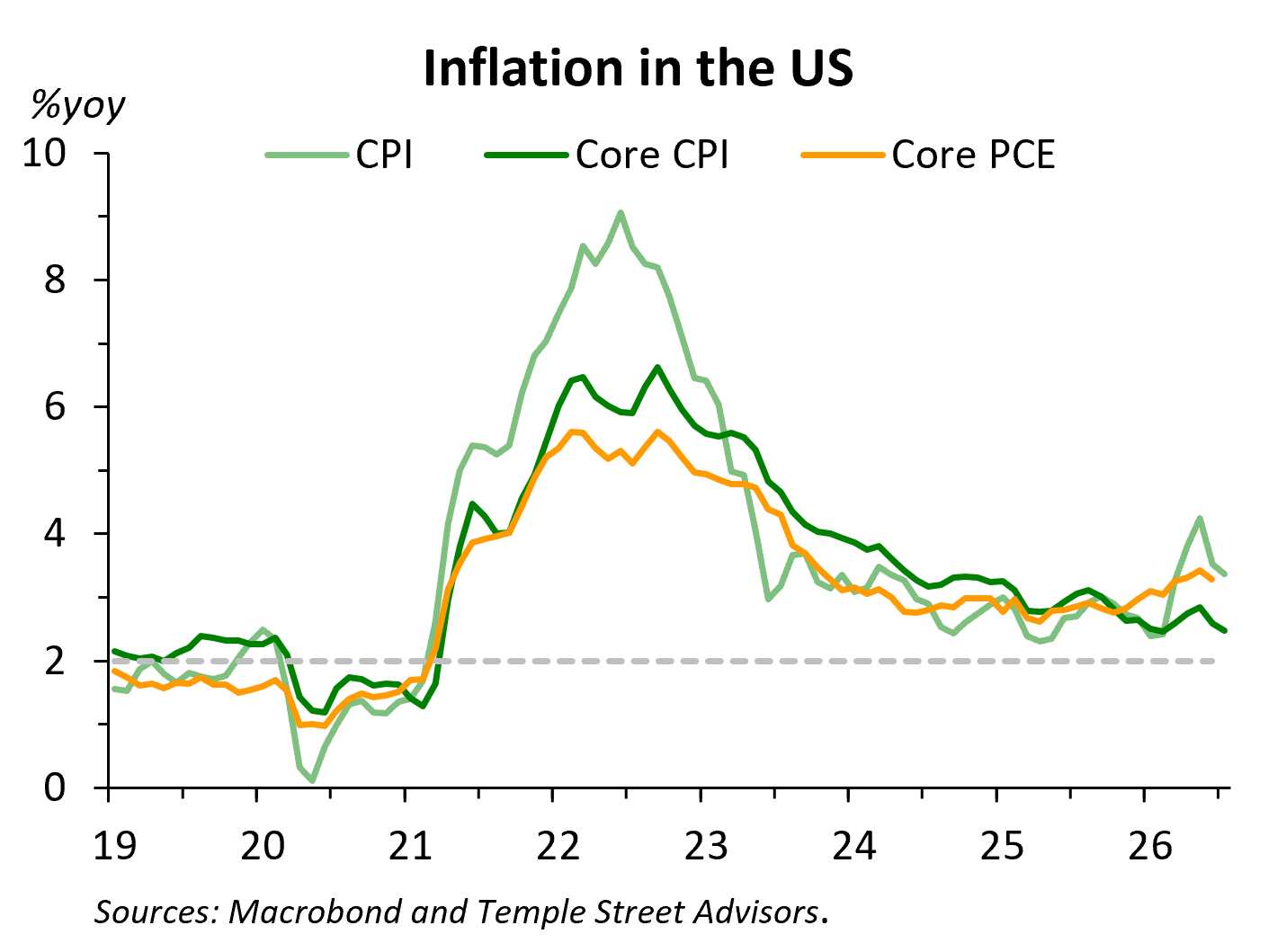
Month-on-month, seasonally adjusted core CPI rose 0.2% after being unchanged in June. The core inflation impulse — 3m/3m saar — is 2.4%, which is the slowest in six months. If core CPI rises 0.2% again in August, the 3m/3m rate would fall to 1.8% and the YoY rate of change would fall to 2.35%, the lowest since March 2021. Hope isn’t a strategy, as the saying goes, but it seems to be working for Warsh.
December Fed funds futures fell 6bps last week, mostly after the CPI print. Almost one rate hike is still priced in by year-end — more likely in December itself now — but three weeks ago nearly two rate hikes were priced in. Almost one whole rate hike has been removed from the December futures price since July 23 and the December 2027 futures price has less than half a rate hike added. Bond yields are a couple of basis points higher than they were a week ago, but are lower than they were on Monday through Wednesday.
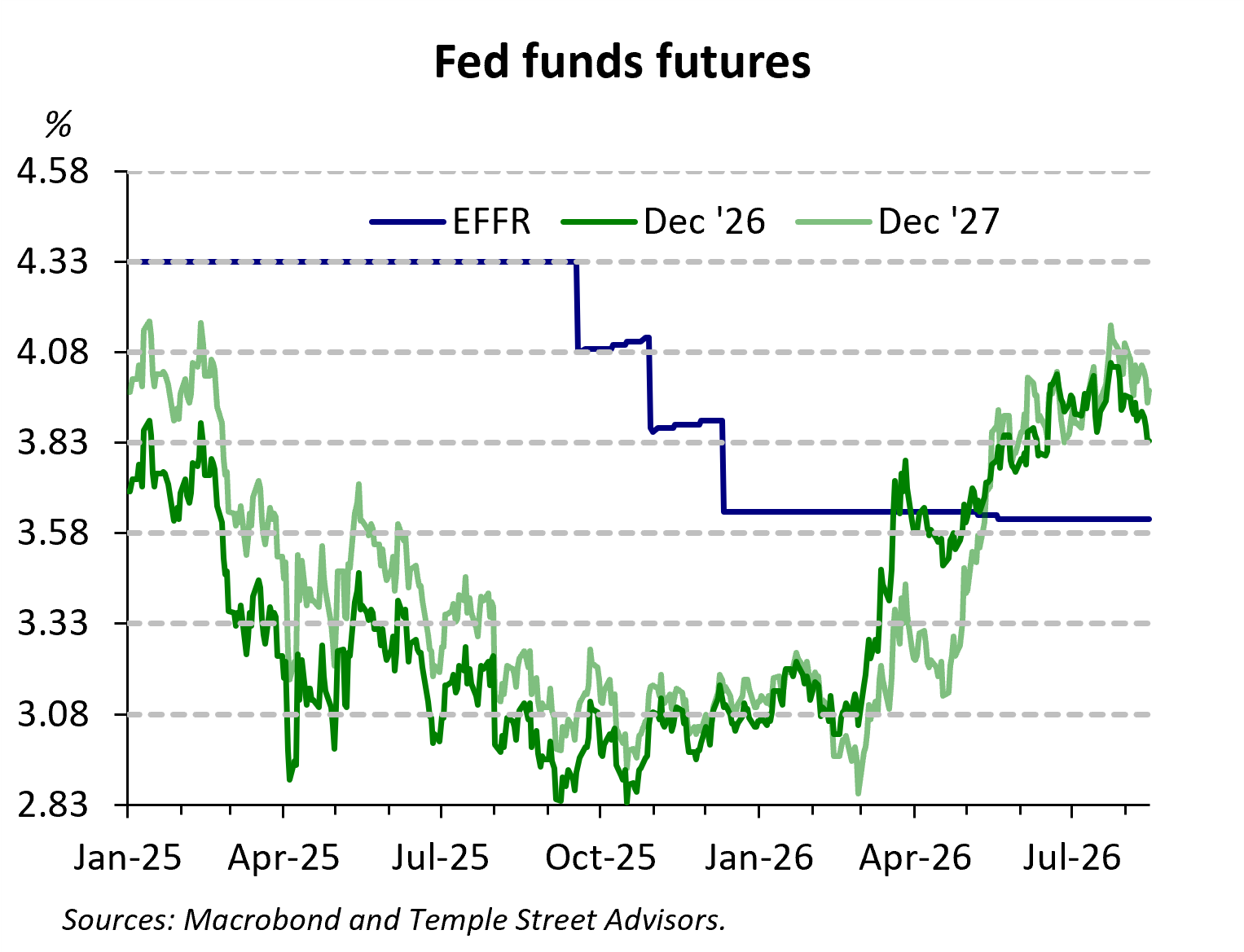
So the market is gradually revising its view on the Fed. After a hawkish hold at his first FOMC meeting on June 16-17 — although Warsh said he didn’t even offer the committee the option to hike rates — and then a seemingly very dovish second meeting on July 28-29, the slowing of CPI inflation (much less so in PCE inflation so far) is being viewed as tipping the balance much more towards no rate hike at all.
Real yields on US Treasuries were about unchanged last week — the 5yr real yield was 2bps higher on Friday than a week earlier and the 10yr real yield was 1bps higher but both had been higher still prior to the CPI report. Following the same path, the US dollar TWI rose in the first part of the week and then fell after the CPI report, but still ended the week slightly higher.
Significantly — and still puzzling to some market participants and commentators, it appears — even though both nominal and real yields on Japanese government bonds rose more than their USD counterparts the yen fell by 0.5% last week. After the intervention on July 30-31 pushed the currency about 5.5% stronger by the early morning on August 3, it has fallen back by about 3%.
Readers of Talking Points won’t be surprised though. I first commented on the anomalous response of the yen to interest rate differentials since early April 2025 in the May 25, 2025 edition of this newsletter. At the time, it was behavior shared with other APAC currencies. But the anomaly remains for the yen more than a year later and I have frequently drawn your attention to it. Higher yields on JPY bonds relative to USD bonds have been associated with a weaker yen, not a stronger yen. This suggests that higher rates are building in a rising risk premium and so are making investors less likely to buy the bonds, not more likely.
….more…


